
P&P-HVD
High Velocity Dispenser
Prepares self-adhesive die-cuts together on a conveyor belt for continuous robot picking, supporting series production processes with short cycle times.
What Is the P&P-HVD?
The P&P-HVD is a system that supplies large quantities of die-cuts to Pick & Place robots in a short time.
It peels die-cuts from a roll-fed liner, transfers them onto the P&P-HVD's conveyor belt, and carries them to the robot's pick area. In its standard configuration it supports liners up to 200 mm wide, allowing die-cuts to be arranged in multiple rows across that width. Because different part types and sizes can also be combined on a single roll, large quantities of die-cuts can be prepared together on the conveyor belt, so the robot never has to wait for the feeder to dispense the next part one at a time. This makes it a Pick & Place feeding method well suited to series production processes that demand high throughput.
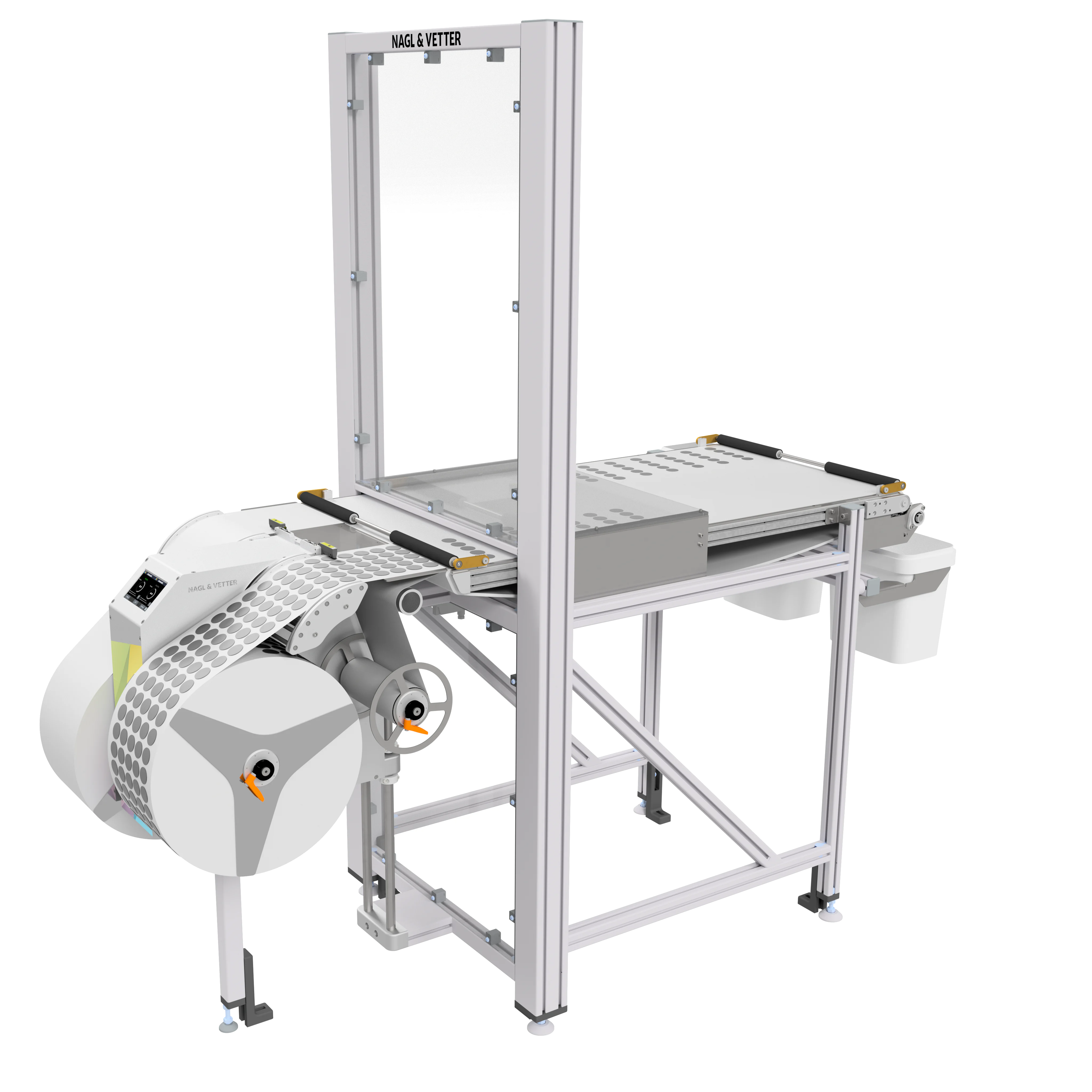
STATUS INFORMATION MULTI-LANE
DIE-CUT DISPENSING PREPARED FOR
CAMERA MONITORING
Using the Workpiece-Change Window to Prepare the Next Batch
Rather than feeding one die-cut at a time for every robot pick, the P&P-HVD prepares the large batch of parts needed next on the conveyor belt before the robot even starts picking.
In a typical series production line, a brief window opens up between the processed workpiece moving on to the next step and the next workpiece arriving. The P&P-HVD uses this window to feed the die-cuts needed for the next workpiece onto the conveyor belt. Once the die-cuts are set at the pick position, the conveyor belt stops and a camera measures the positions of every die-cut in the pick area in a single pass. Depending on the equipment configuration, the robot tool can even begin picking before the next workpiece reaches its processing position, not just feeding and position measurement.
Especially when using a robot tool that can hold multiple die-cuts, picking them in advance during the workpiece change lets part of the loading time for the robot tool be handled outside the equipment cycle. By the time the workpiece reaches its designated position, the robot can already begin the application process using parts it has prepared beforehand.
High Throughput and Positioning Accuracy Together
The P&P-HVD's strength is combining high throughput with positioning accuracy.
A camera measures the position of each die-cut on the conveyor belt, and the robot picks precisely based on that position data. Because the robot never has to wait for the P&P-HVD to dispense parts one at a time during picking, it can pick die-cuts continuously. Processing speed is determined mainly by the robots and robot tools used, as well as their number and configuration.
Robots and robot tools can be added to match the required throughput, so capacity can be scaled to fit the equipment configuration.
A Special Conveyor Belt Where the Adhesive Side Won't Stick
Even once a die-cut is transferred onto the conveyor belt, the robot cannot pick it reliably if its adhesive side sticks too firmly.
The P&P-HVD uses a special conveyor belt that self-adhesive die-cuts barely stick to, so a suction pad can pick parts off the conveyor belt smoothly.
The conveyor belt is also available in white or dark blue to ensure high contrast for the camera's position measurement, so you can choose whichever color suits your die-cuts for reliable image recognition.
Belt color, selected for camera contrast
Supplying Multiple Robots from a Single P&P-HVD
A P&P-HVD typically feeds one type of die-cut, often from a material roll with the same part arranged in multiple rows on the liner. Rolls that combine different part types and sizes on a single roll are also supported.
The P&P-HVD's conveyor belt length can be adapted to the equipment configuration, and by setting up multiple pick zones along its length, a single P&P-HVD can supply several robots using the same die-cut. Separating the pick zones lets the robots pick without interfering with one another, so there is no need to install a separate feeder for each robot. Depending on the configuration, this can reduce the number of feeders needed and lower overall equipment cost.
Choosing a Camera System to Match Your Equipment
Typically, a stationary camera system is used to detect the position of die-cuts on the conveyor belt. The P&P-HVD has a mounting position prepared in advance for installing the camera.
The camera works together with the robot rather than the P&P-HVD itself, passing the detected part positions to the robot. Selecting and integrating the camera system is generally the responsibility of the user or integrator.
Nagl & Vetter recommends SensoPart camera systems for position detection on the P&P-HVD, but camera systems from other manufacturers can also be used if preferred.
Two-Sided Material Feed for High System Availability
The P&P-HVD loads the same material roll onto both the left and right feed sides, using them one after the other. If the roll on the active side runs out or a feed error occurs, the system automatically switches to the other side, keeping die-cut supply going while avoiding equipment stoppages from material depletion or feed errors.
After switching, the camera detects the position of the newly supplied die-cuts and passes that position data to the robot.
Supply Continues Even With Missing or Defective Material
Every time the conveyor belt advances to its designated position and stops, the camera detects the positions of the intact die-cuts and reports them to the robot. Positions of missing or defective die-cuts on the liner are never sent to the robot; only the positions of the good parts to be picked are transmitted. Based on this information, the robot picks die-cuts according to a preset priority order, so picking continues without interruption even where parts are missing or defective.
Die-cuts the robot does not pick are ejected at the end of the conveyor belt. Options such as passive or driven reject brushes and a waste container are available for this ejection.
Safe Material Changeover From Outside the Robot Cell
The P&P-HVD's material feed can be positioned outside the robot cell, so operators can change or refill material rolls without ever entering the robot's working area.
The controls for changing material rolls and manual operation are placed outside the cell, while the conveyor belt can be arranged to span from outside the cell to the inside. The P&P-HVD includes a tunnel-style cover over the conveyor belt and a fixed partition panel with a slot for the conveyor belt to pass through. During installation, an opening matching the robot cell's safety fencing is provided, and fitting the P&P-HVD into it makes the unit part of the safety fencing.
Inside the cell, camera-based position detection and robot picking take place in the same area of the conveyor belt. Where multiple pick zones are set up, position detection is performed separately in each zone. This keeps the area where operators handle material physically separated from the area where the robot operates, while still allowing die-cuts to be conveyed into the cell.
Outside the cell
Operator access
Cell wall
Conveyor belt pass-through
Inside the cell
Robot workspace
Custom Solutions for Materials Beyond the Standard Specification
For materials beyond the standard specification, custom configurations can be considered depending on the application and the number of units involved. For example, for lightweight foam pad applications, a custom version extending the standard specification to support a maximum liner width of 300 mm and a maximum roll diameter of 500 mm has already been developed and built.
A Special Version That Also Handles Rigid Parts
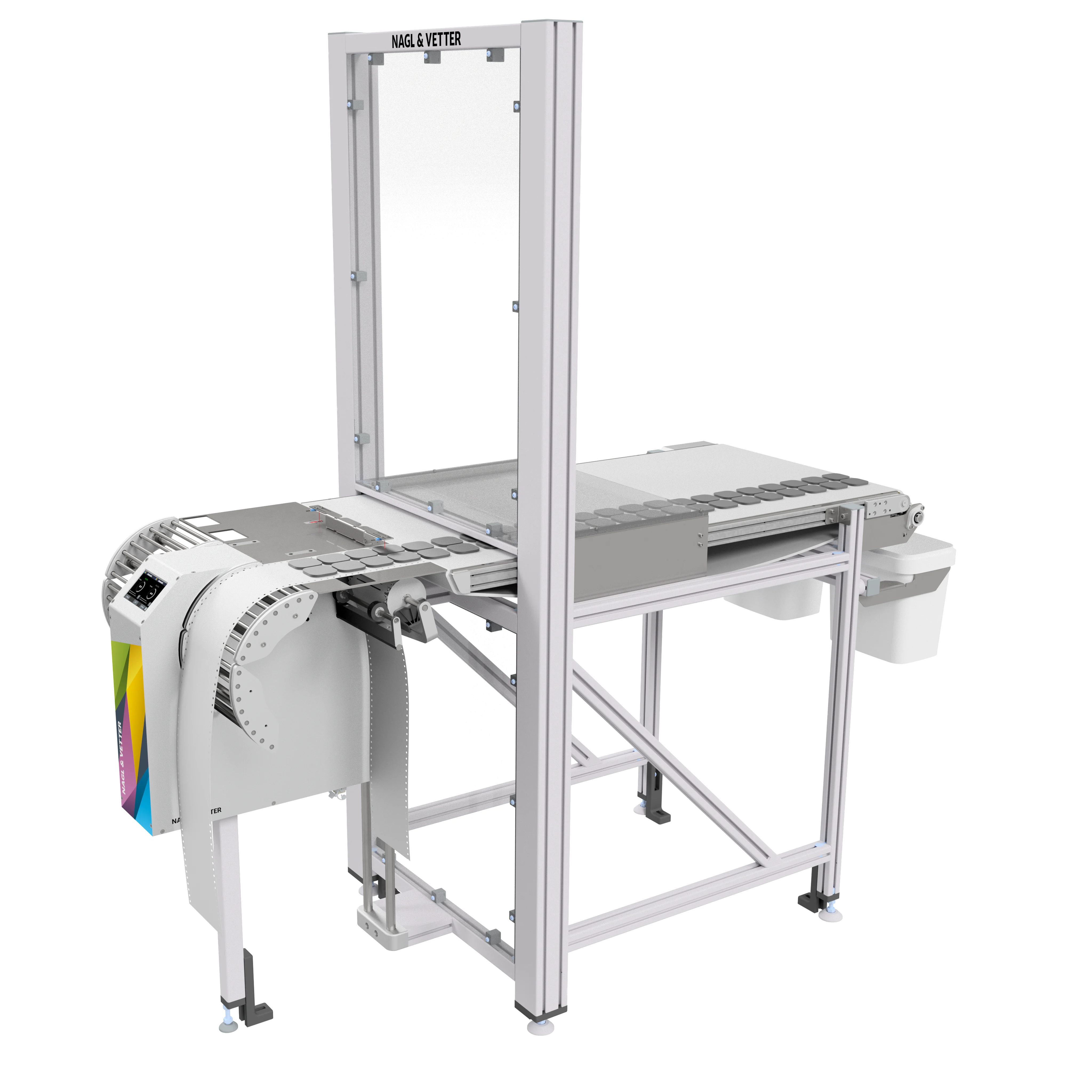
This version is a special specification for liners carrying parts that are difficult to wind into a roll, such as self-adhesive plastic parts.
Continuous feed perforations along both edges of the liner let the P&P-HVD automatically pull an accordion-folded liner out of its box and feed it directly, so there is no need to remove the liner from the box beforehand.
This method is already used in series production, and by adapting the material to suit this feeding method, it extends automation to the application of harder parts that have traditionally often been applied by hand.
Designed to Minimize Integration Effort
The P&P-HVD has built-in control functions, keeping its connection to the equipment's system control simple by design.
It communicates via PROFINET or EtherNet/IP, receiving material feed and conveyor belt motion commands while sending information such as the remaining material on each side, readiness, the feed side currently in use, and fault codes to the equipment side. This information can also be used for displays, warnings and maintenance information on the equipment side.
Required settings can also be managed centrally from the system control and loaded onto the P&P-HVD via fieldbus. Because there is no need to control the device's internal functions individually from above, this reduces the programming, validation and commissioning effort needed for integration.
Technical Specifications
| Dimensions (W × H × D) | 804 × 1.985 × 1.750 mm |
| Weight | 125 kg |
| Liner width | Standard range 30–200 mm |
| Max. roll diameter | 400 mm |
| Roll core | 3" (76.2 mm) or 6" (152.4 mm) |
| Material feed | Two feed sides (left/right) |
| Communication | PROFINET / EtherNet/IP |
A Technology Proven in Series Production
Like the i-DCA and P&P-DCD, the P&P-HVD has built up a steady track record automatically feeding die-cuts at automotive plants worldwide, including in China, Mexico, Canada, Italy and Hungary.
The special version that feeds rigid, self-adhesive parts from an accordion-folded liner is also in continuous use in series production.
P&P-HVD technology is patented in Europe and the United States.
Could Your Parts Be Supplied Automatically Too?
We'll propose how the P&P-HVD can automatically supply your parts, tailored to your production process. Feel free to get in touch.
Get in Touch